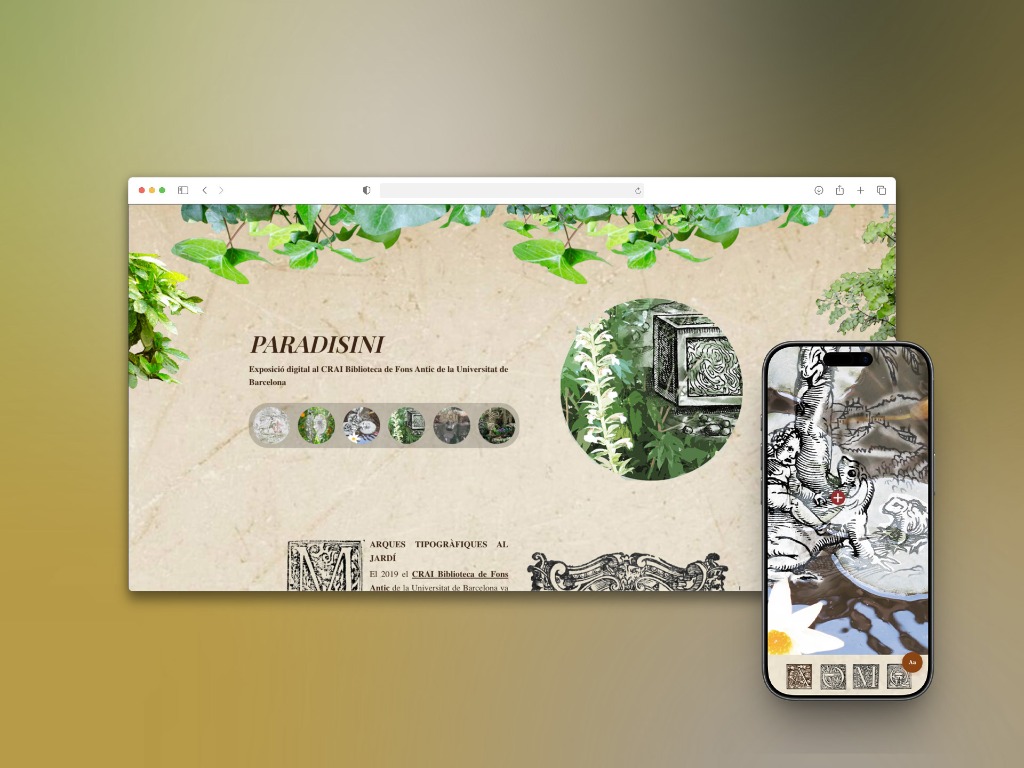
Paradisini

Digital exhibition for the CRAI Rare Book Library that brings a collection of historical printer marks and their link to the University of Barcelona's historic garden into the web environment.

Role UX/UI Designer
Timeline 4 Weeks
Tools Figma, Premiere, Photoshop
Paradisini Exhibition Showcase
01

The Challenge

From physical exhibition to virtual prototype

The CRAI Rare Book Library holds 2,803 printer marks from 1,900 printers, the result of 20 years of research documented in the "Marques d'impressors" database.

Paradisini was a physical exhibition that presented these marks in relation to the garden of the University of Barcelona's Historic Building as a metaphor: the garden as a cultivated space and the book as the cultivation of knowledge.

However, the physical exhibition faced major limitations: only 2,744 annual visits in Barcelona, difficult physical access, limited time, and mostly academic audience (78% specialized).

The challenge was to transform an experience bounded by space and time into a scalable digital one that would exponentially expand reach, open the collection to non-specialized audiences, and maintain academic depth without scaring off casual visitors with dense text.

02

Context

Format shift: from academic catalog to web storytelling

Academic content is typically presented as dense blocks of text, chronological lists, or technical specifications that work well in papers and books but not on screens.

The project required inventing a new information architecture: fragmenting the narrative into accessible layers, creating visual entry points, linking internal references, and designing an experience that invited both scholars and curious visitors to explore the marks.

The "digital garden" metaphor was not just visual, but structural: instead of linear navigation, the design allowed multiple exploration paths (by mark, by printer, by historical context, by visual gallery), reflecting how a real visitor traverses a garden: jumping from point to point based on interest.

Additionally, user research showed that this profile (academics and students) prefers consuming content on desktop. Therefore, the desktop experience was prioritized (Desktop First), leveraging the large screen to showcase detailed engravings and improve readability, without neglecting the mobile version.

Thus, Paradisini sought to demonstrate that academic content, if structured and presented correctly, can be just as attractive and accessible as any other digital experience, without losing rigor or depth.
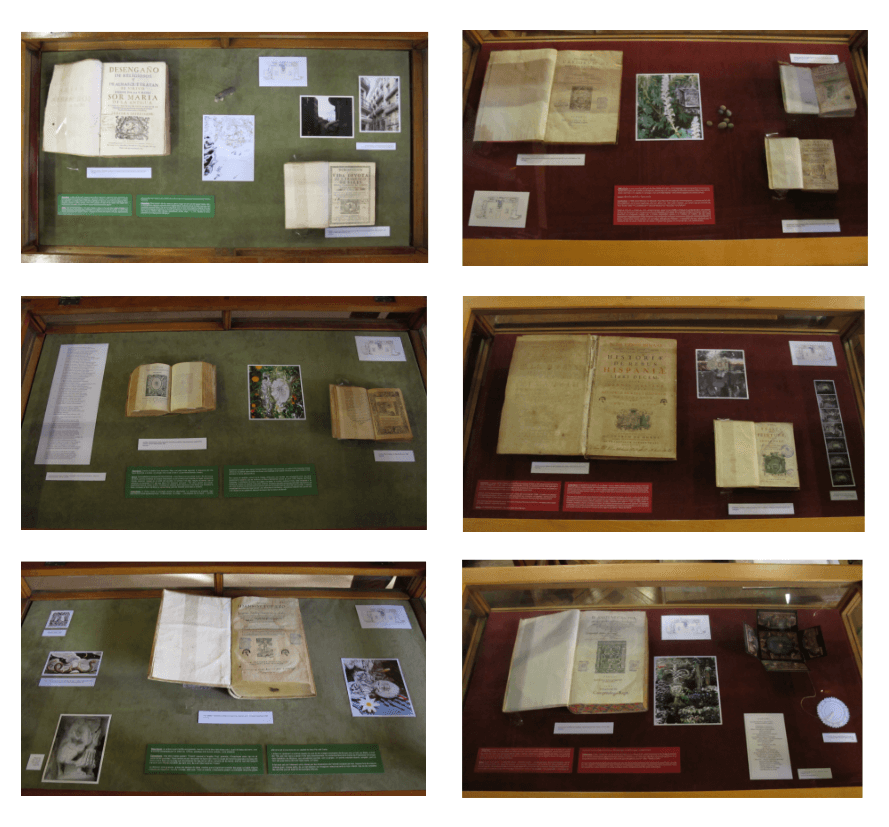
Original Physical Exhibition (Before)
03

The Experience

From room tour to screen tour

In the physical exhibition, the visitor walked through showcases and panels in a concrete space for a limited time; in the digital version, the challenge was translating that tour to an interface that could be consulted from anywhere at any time, without losing the feeling of strolling through the garden.

The home acts as an entrance to the digital museum: it introduces Paradisini, situates the context of the Rare Book Library, and offers clear access to showcases and pieces, inspired by references like Gallica and collections sections of major museums.

Snake Character

W. Blake, America a prophecy (1793), detail of plate 13 – Copy O, printed 1821
(at: The William Blake Archive)

Instead of reproducing physical panels as-is, the experience is organized into short, scannable modules: each showcase becomes a page with featured images, introductory text, and links leading the user to more detail or the "Marques d'impressors" database.

This format change allows moving from a continuous, dense discourse to layered navigation, where the user decides how deep to go, maintaining academic rigor but adapting it to digital reading rhythms.

The information architecture is designed for mixed audiences: researchers, students, and general public.

To achieve this, clear titles, guiding subtitles, contextual links, and a system of showcase pages are combined, acting as intermediate nodes between freer "garden" exploration and access to highly specialized resources.

04

Results

Impact and usage behavior (last month)

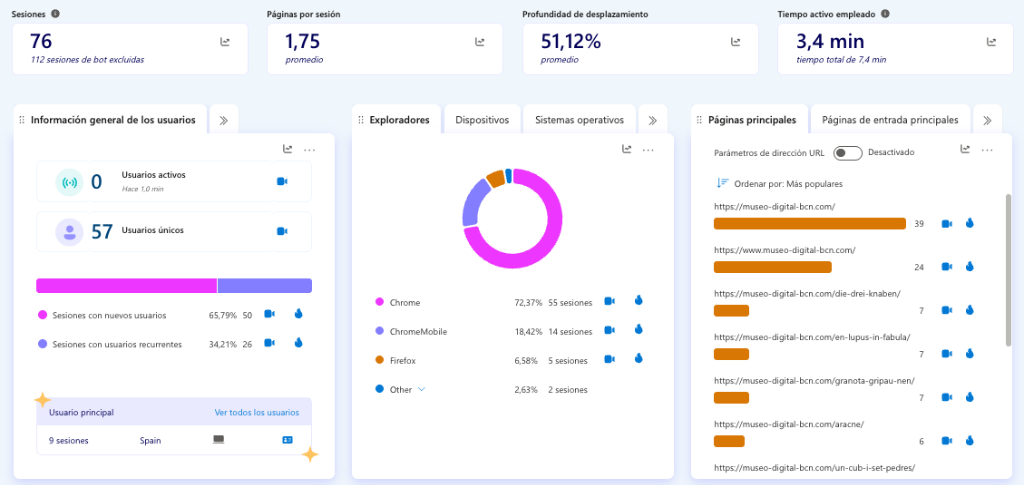
In the last month, the digital museum recorded 72 real sessions (113 including bots) and 54 unique users.

65.28% of sessions come from new users (47 sessions) and 34.72% from returning users (25 sessions), indicating the project is still in discovery phase but already generating returns.

Most sessions come from Spain. Regarding devices, Chrome Desktop accounts for 73.61% of sessions (53), followed by Chrome Mobile with 16.67% (12).

The average of 1.71 pages per session and 50.79% scroll depth show exploration is still superficial: many users stay in the visible area.

However, the home page is clearly the most visited, followed by individual exhibitions like "Die drei Knaben", "Granota gripau nen", "Aracne", indicating interest in specific works when users reach them.

Based on this data, next iterations aim to increase navigation depth (links to "see more exhibitions" and related works), improve engagement with more visual content, and resolve missed click patterns detected in heatmaps.

Metrics Dashboard
72 Real Sessions (last month)
54 Unique Users
65% New Users
73% Chrome Desktop

Next Project